





Buying a first electric guitar means comparing usable setups, especially when a new kit and a used instrument appear at similar prices. Start with the sounds and playing feel you want, then count the missing equipment on each side. A lower guitar price is not always a lower complete cost.
This electric guitar buying guide takes you through those decisions in order. It includes acoustic-electric instruments as a separate amplified sound choice, not as a compulsory step before electric guitar.
Donner’s Black Friday/Cyber Monday 2026 campaign runs through a November 5–18 warm-up, November 19–30 main event and December 1–3 return event. The Christmas campaign follows on December 4–25.
Choose by Sound, Feel and Setup
- Start with Your Music and Listening Setup
- Separate Body Construction from Pickup Type
- Choose the Pickup Sounds You Want
- Compare Neck Feel, Scale and Playing Position
- Choose a Bridge You Can Maintain
- Check the Complete Setup Before Paying
- Compare a New Kit with a Used Guitar
- Try These Checks Before You Commit
Start with Your Music and Listening Setup
Choose two familiar songs and listen to the guitar part: clear chords, a driven riff or an amplified acoustic texture. Take those examples into a comparison. Trying the same short passage is more useful than choosing a guitar because its shape resembles the one in a video.
Decide where you will play. A speaker needs a suitable amplifier; quiet practice needs a supported wired headphone path. A computer arrangement needs an instrument-input interface and monitoring. Reserve part of the budget for that path, an instrument cable, tuning, support and protection. The price of the guitar alone does not tell you what you can do when it arrives.
Separate Body Construction from Pickup Type
Body construction and pickup type describe different things. Solid-body, semi-hollow and hollow-body electrics can all use magnetic pickups. A hollow space in the body does not turn an electric into an acoustic-electric.
An acoustic-electric uses an acoustic-oriented pickup system, with a preamp where specified. Minimal-body electroacoustic travel instruments belong to that sound path too, but do not provide the unplugged volume of a full acoustic body. Choose their amplification by the actual output and electronics.
Headless describes the location of tuning hardware. It says nothing by itself about pickups or onboard headphones. Keep the body, sound system and tuning layout as three separate decisions.
Choose the Pickup Sounds You Want
A single coil gives a useful starting reference for clear, bright sounds. A humbucker combines two coils to reduce pickup hum and commonly offers a fuller starting sound. Either can work across musical styles; the guitar's controls, amplifier and playing technique also shape the result.
SSS means three single coils. HSS combines a humbucker with two single coils; HS combines a humbucker and one single coil. The letters do not specify every available switch position. If coil splitting is provided, it uses one humbucker coil for another sound, not an exact copy of every separate single-coil design.
Try a slow chord pattern with a clean amp setting, then a short riff with some drive. Change the pickup position without changing the whole amp setup. Listen for note separation, attack and hum at the settings you expect to use. Hum cancellation is not a guarantee of a completely silent signal chain.
Donner DST-152 Pickup Flexibility

Pros
- HSS layout with five-way selection
- Coil split adds another pickup option
Cons
- More switching functions to learn
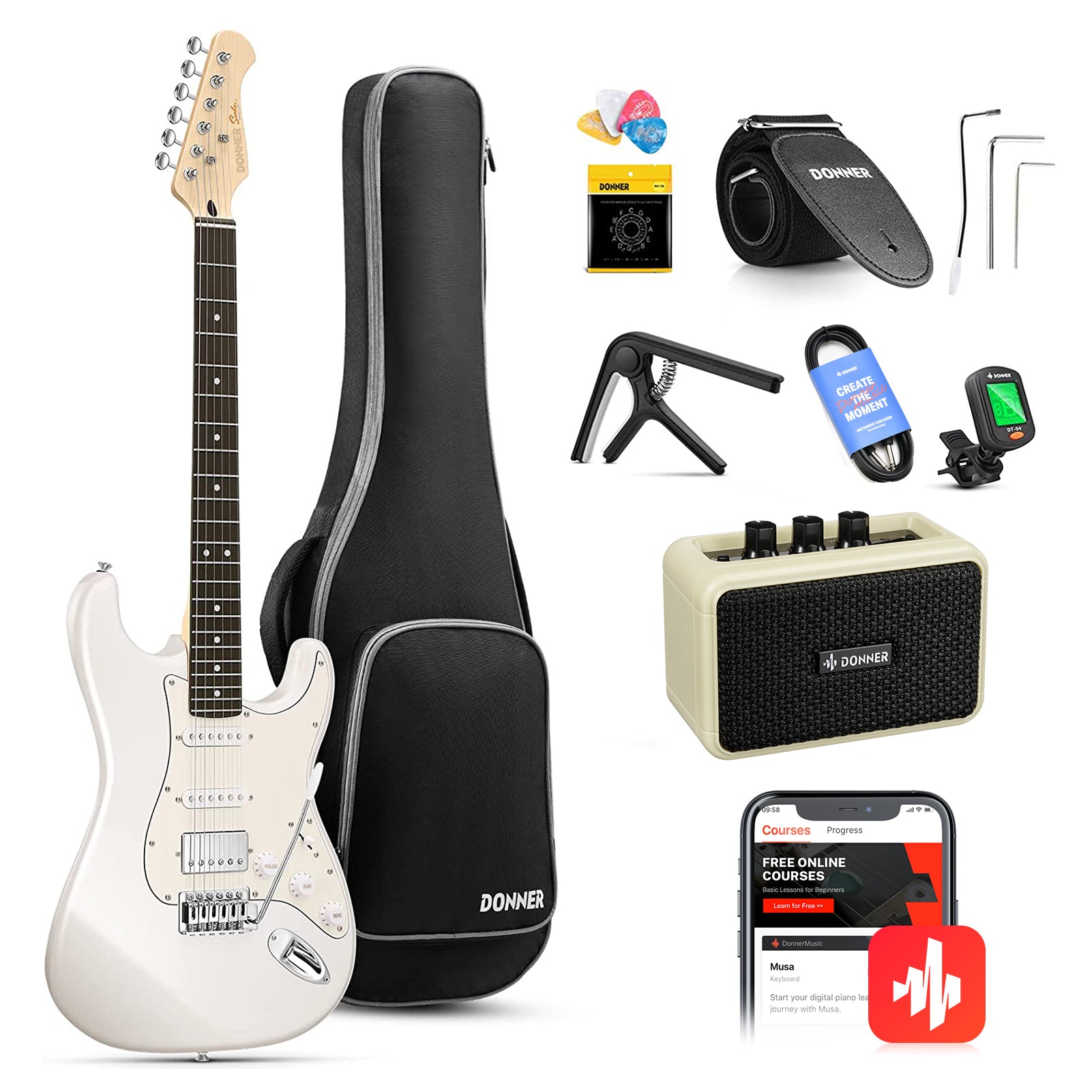
Donner DST-152 electric guitar gives a beginner several sounds to explore on one guitar. Its HSS layout, five-way selector and push-pull coil split let you compare a bridge humbucker with single-coil positions. Learn the switch and split separately so you can repeat a sound rather than changing controls at random.
The C-profile bolt-on neck has 22 frets, with conventional tuners and a synchronised tremolo. Try the neck and check tuning after using the arm. Any mini amplifier supplied in the selected package is external; its listening features are separate from the guitar's controls.
Compare Neck Feel, Scale and Playing Position
Hold the guitar seated and standing with a strap. Reach the first frets, form a comfortable chord grip and move higher up the neck. Notice whether the body stays balanced or your fretting hand has to support it. Controls should be within reach without forcing your arm out of position.
Neck profile describes the shape in your hand; scale length describes the vibrating string length. A compact body can retain a full-length playing area. Compare fret reach and string feel rather than assuming headless means short scale. Handedness and a playable setup matter more immediately than decorative wood labels. Persistent buzzing or a painful grip calls for assessment before purchase.
Donner HLX-500 Full-Scale Headless Electric

Pros
- Compact tuning layout without a headstock
- HSS pickups with five-way switching
Cons
- Requires an external amp or listening device
Donner HLX-500 electric guitar makes sense as a separate instrument purchase when you want headless hardware and magnetic HSS sounds. Compare its 25.5-inch scale, 24 frets and asymmetrical neck with the conventional guitar in the kit, not with the size of the shipping box. The compact outline does not remove the normal playing reach.
Five-way switching, one volume and one tone control provide the main sound adjustments, with tuning at the bridge. The conventional output still needs an external amp or listening device. Include that equipment in the same complete-cost comparison you use for a used guitar; headless does not add a headphone amp.
Choose a Bridge You Can Maintain
A fixed bridge gives you fewer moving setup variables when tuning or changing strings. It is a straightforward choice when tremolo effects are not part of the sound you want.
A tremolo bridge lets you move pitch with an arm. Using it, or changing string gauge, adds adjustment variables. Try tuning before and after using the arm. With a headless model, learn where and how its bridge tuners work. No bridge category guarantees stable tuning under every condition.
Check the Complete Setup Before Paying
Trace the route from instrument to ears. For a conventional electric, that usually means instrument output, instrument cable and suitable amp or listening device. Headphones connect to a supported headphone output on that device, not automatically to the guitar jack.
For an acoustic-electric, identify the specified pickup/preamp output and compatible monitoring. For any kit, list the exact amplifier, cable, tuner, strap and protective items, then add what is missing. A bundled amp remains an external device. USB may serve functions other than audio recording; Bluetooth may receive backing tracks rather than transmit your playing to headphones. Confirm the supported audio path rather than relying on connector names.
Compare a New Kit with a Used Guitar
A used guitar can be worthwhile, but compare the whole purchase with the selected new kit. Add any missing amplifier, cable, tuner, strap and protection, and allow for an assessment of its setup. A low asking price is not evidence that the controls, frets or listening path work.
Play it through a clean amp, test every switch and control, and inspect repeated notes across the neck. Confirm the included equipment and the seller agreement before paying. Compare the resulting usable setups, not a boxed accessory count against a bare used instrument.
Try These Checks Before You Commit
Use the same clean amp settings when comparing guitars. Tune first, play notes across the usable neck and test each pickup position. Turn volume and tone controls while listening for the expected changes and for intermittent output.
Repeat the trial seated and standing, then test the headphone or interface arrangement you will use at home. Ask for an adjustment or inspection if notes buzz persistently, controls fail or the playing position hurts. Make the decision after another trial, not on the assumption that a fault will disappear with practice.
Questions Before You Buy
Do I Need to Learn Acoustic Guitar First?
No. You can begin on an electric guitar when it suits your music, playing feel and listening setup. Acoustic guitar is not a prerequisite. Choose an instrument you can hold comfortably and a practice arrangement you can use regularly.
Can I Reverse the Strings for Left-Handed Playing?
Not automatically. Nut slots, bridge compensation, body shape and control placement can make a simple reversal unsuitable. Buy the intended orientation or obtain advice for that exact model before planning a conversion.
Buy a Playable Setup Rather Than More Specifications
Choose the sound system first, then the instrument you can hold and maintain comfortably. Complete the decision by testing how you will hear it. A playable guitar with a working listening path gives you somewhere to begin; extra specifications cannot replace either part.